Monday, 13 July 2015

Spinal Cord-Control and Coordination:

spinal cord:

It is the ling cylindrical part of CNS. It is present in neural canal of vertebral column. It is the center of all reflex actions. . Grey matter, which has a pinkish-grey color in the living brain, contains the cell bodies, dendrites and axon terminals of neurons, so it is where all synapses are. White matter is made of axons connecting different parts of grey matter to each other. In spinal cord grey matter is inside and white matter is outside. Major functions of spinal cord are:
  1. It acts as the main center for reflex actions.
    2.   It acts as a link between spinal nerves and brain. Thus it participates in conscious actions.


Funtions related to Spinal Cord

Sunday, 12 July 2015

Human Brain - Control and Coordination :

Human brain is a highly complex organ; which is mainly composed of the nervous tissue. The tissues are highly folded to accommodate a larger surface area in less space. The brain is covered by a three layered system of membranes; called meninges. Cerebrospinal fluid is filled between the meninges. The CSF provides cushion to the brain against mechanical shocks. Furthermore, the brain is housed inside the skull for optimum protection. The human brain can be divided into three regions, viz. forebrain, midbrain and hindbrain.
Click here to watch the video.

Parts of Human Brain:

  • Forebrain: It is composed of the Thalamus, Hypothalamus and cerebrum.
  • Midbrain
  • Hindbrain: It is composed of the cerebellum, pons and medulla oblongata.


Forebrain:


Thalamus:

he thalamus functions to relay sensory information to the cerebral cortex and the hypothalamus, regulating visceral functions including temperature, reproductive functions, eating, sleeping and the display of emotion.

The Hypothalamus :

  • A section of the brain found next to the thalamus that is involved in many regulatory functions such as osmoregulation and thermoregulation. The hypothalamus has a degree of control over the pituitary gland, another part of the brain situated next to it, and also controls sleeping patterns, eating and drinking and speech. The hypothalamus is also responsible for the secretion of ADH (Anti-Diuretic Hormone) via its neurosecretory cells

The Cerebrum  

The cerebrum is the largest part of the human brain and the part responsible for intelligence and creativity, and also involved in memory. The 'grey matter' of the cerebrum is the cerebral cortex, the centre that receives information from the thalamus and all the other lower centres in the brain.

The Cerebral Cortex 

- Part of the cerebrum, this part of the brain deals with almost all of the higher functions of an intelligent being. It is this part of brain that deals with the mases of information incoming from the periphery nervous system, furiously instructing the brain of what is going on inside its body and the external environment. It is this part that translates our nervous impulses into understandable quantifiable feelings and thoughts

Mid Brain:

 The midbrain is located below the cerebral cortex, and above the hindbrain placing it near the center of the brain.

Hind Brain:


Cerebellum:

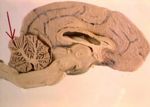
 Cerebellum lies below the cerebrum and at the back of the whole structure. It coordinates the motor functions. When you are riding your bicycle; the perfect coordination between your pedaling and steering control is achieved by the cerebellum.

Medulla: Medulla forms the brain stem; along with the pons. It lies at the base of the brain and continues into the spinal cord. Medulla controls various involuntary functions;
like hear beat, respiration, etc.

Pons:

The pons can be found in the metencephalon region of the hind brain. As shown above, the pons is able to exert some influence on respiratory movements and can also influence many digestive processes

Saturday, 11 July 2015

Nerves-Cordination And Control:

Definition of Nerve:

nerve is an enclosed, cable-like bundle of axons (the long, slender projections of neurons) in the peripheral nervous system.

Types of Nerves:

Sensory Nerves:

nerve that passes impulses from receptors toward or to the central nervous system and  have axons of sensory neurons.

Motor Nerves:

A nerve carrying impulses from the brain or spinal cord to a muscle or gland and have axons of only motor neurons

Mixed Nerves: Mixed nerves have axons of both motor and sensory neurons.


  Coordination and Control:

Components of nervous system
1. Neurons (nerve cells)
The structural and functional unit of the nervous
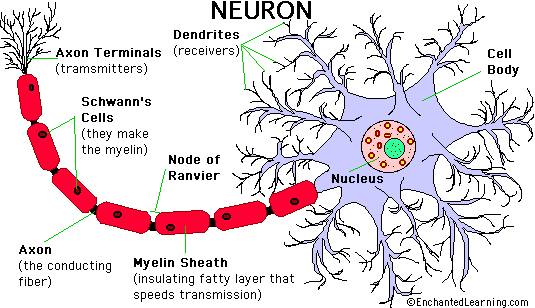
system in all animals including man is the neuron. This is a highly specialized cell which contains the typical organelles found in most eukaryotic cells. This cell is highly adapted for communication because of its wire like projection; the dendrites which are often further branched and carry impulses towards the central cell body. The cell body is a thicker region of the neuron containing the nucleus and most of the cytoplasm. The axon is the projection, generally very long, that carries impulses away from the cell body. Usually a neuron has a single axon. Fatty substances covering the axon is the myelin sheath along with short regions of exposed axon are called nodes of Ranvier. Many axons and even dendrites combine to form a single nerve.

a-neuron
Neurons are of three types.
a)Sensory neurons: they carry nerve impulses (message from receptors to central nervous system.
b)Motor neurons: they carry nerve impulse (orders) from central nervous system to effectors.
c)Associated neurons: they form central nervous system and are responsible for analyzing the message and issuing orders.

Composition of Neuron:

Aneuron is ade up of three components.
1-Axon
2-Dendrites
3-Soma

.
There are several differences between axons and dendrites:
Axons             Dendrites
  • Take information away from the cell body
  • Smooth Surface
  • Generally only 1 axon per cell
  • No ribosomes
  • Can have myelin


  • Bring information to the cell body
  • Rough Surface (dendritic spines)
  • Usually many dendrites per cell
  • Have ribosomes
  • No myelin insulation
  • Branch near the cell body


Coordination And Control-Inrtoduction:

In organisms, various organs and systems participate and play their role as and when required. Every organ of an organism does not work continuously except the heart, brain and lungs, which according to their role in the body are required to work 24 hours a day.
You can imagine what a bizarre scene it would present, if you want to lift an object in which you are required to use your both hands but your hand do not follow your command or if one of your hand is trying to lift it and the other hand is opposing it at the same time, their would surely be a chaotic situation.
For proper functioning of the body of an organisms, it is therefore, necessary that various organ and system work only when required, do their right type of job and also should not overdo or under do their jobs, when more than one organs are involved in an activity all the organs should operate in a sequence for the successful accomplishment of that particular function. All these attributes of physiology can be achieved when the body works as one unit, in which its different organs and systems cooperate and work in harmony with each other, i.e. its various functions are coordinated. Their coordination can ensure the successful existence of the organisms.
In animals co-ordination is produced by two systems.
(i)                Nervous system

(ii)              Endocrine system or chemical coordination
al-qasim-trust-reflex_arc1In both types of co-ordinations, the change (stimulus), whether external or internal is perceived by special organs which are called sensory organs. Any activity of an organism, when analyzed can be found to consist of responses. A response is a reaction to some action which takes the form of a stimulus. The stimuli are changes in the environment both external and internal. The change in the environment already mentioned is perceived/felt by special organs of the body, which are specialized to receive efficiently a particular type of stimulus. As for example the sound waves are received by ears. The stimuli of light are received by eyes; the stimuli of smell are received by nose, so on and so forth. Those organs which are specifically build to receive particular type of stimuli are called sensory organs or receptors.
al-qasim-trust-Coordination The information about the stimuli is then conveyed to the brain or spinal cord through neurons or nerves and to the endocrine glands through the blood. The brain or spinal cord and endocrine glands play their role according to the stimuli. The former sending message about the action or response to be made by particular organs. The later by secreting hormones which are poured into blood and transported to the special organs or target organs which produce the response. The organs producing particular responses are known as effectors organs, which are muscles and glands.

Friday, 10 July 2015

Types of coordination:

Nervous Coordination is brought about through the various elements of the nervous system which are:
(i) Receptors                                        (iv) Motor neurons or nerves
(ii) Sensory neurons or nerves            (v) Effectors organs
(iii) Central neurons system (brain and spinal cord), made of associative neurons (inter-neurons)
The stimuli are received by the receptors which convey the messages to the CNS through sensory neurons or nerves. CNS consolidates the information of stimuli, comprehends it and formulates the type of response to be produced. The messages of the type of response are passed via motor neurons or nerves to the particular effectors which produce a specific response.
Nervous coordination is usually involved in producing rapid and short lived responses.

Receptors:
different receptors
 Cells that receives a stimulus (as light or heat) and activates an associated nerve to send a message to the brain and that may be grouped into a sense organ (as a taste bud)


Effectors
An effector is any part of the body that produces the response. Here are some examples of effectors:
  • a muscle contracting to move the arm
  • a muscle squeezing saliva from the salivary gland
  • a gland releasing a hormone into the blood.

Response:

Any behavior of a living organism that results from an externalor internal stimulus


Sunday, 5 July 2015

Kidney Transplant-Homeostasis:

Definition:

A kidney transplant is a surgical procedure to place a kidney from a live or deceased donor into a person whose kidneys have no longer function properly.

Explaination:

Your kidneys remove excess fluid and waste from your blood. When your kidneys lose their filtering ability, dangerous levels of fluid and waste accumulate in your body — a condition known as kidney failure or end-stage kidney disease. A kidney transplant is often the best treatment for kidney failure.
Only one donated kidney is needed to replace two failed kidneys, making living-donor kidney transplantation an option.